


The global beverage industry is anchored by a select group of multinational corporations that command worldwide distribution networks, massive production capacities, and iconic brand portfolios. Companies such as The Coca-Cola Company, PepsiCo, Anheuser-Busch InBev, Nestlé, and Heineken shape consumer preferences across virtually every major market. However, evaluating the true commercial scale of these enterprise leaders requires looking beyond high-level marketing claims.
An accurate industry comparison demands a clear distinction between total corporate conglomerate revenue, dedicated beverage-segment revenue, and public equity valuation. Furthermore, for commercial buyers, retail category managers, and entrepreneurs entering the market, understanding the organizational divide between brand owners, franchise bottlers, and contract manufacturers is essential to navigating the global supply chain.
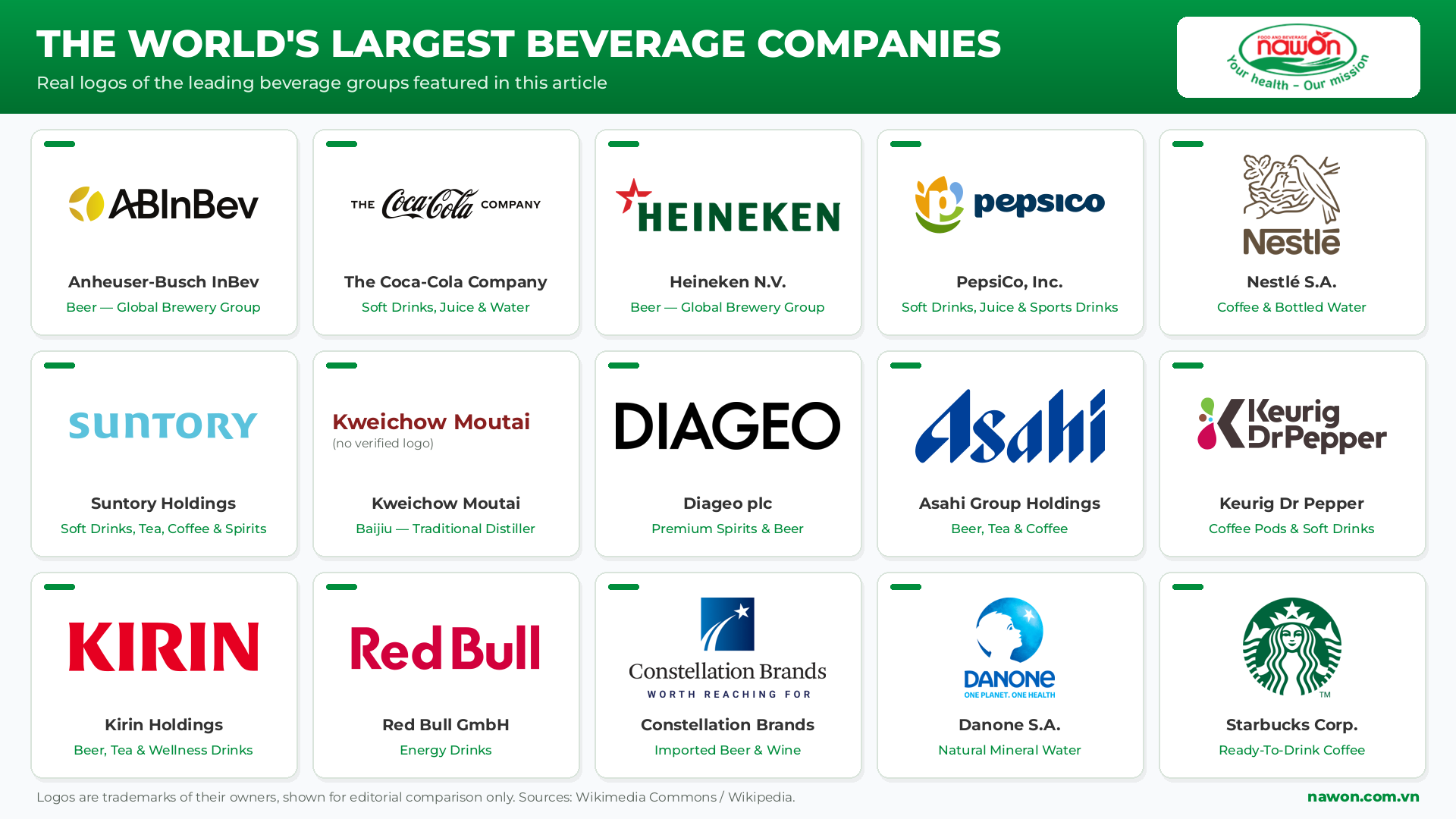
Comparing the Giants: Revenue, Segments, and Market Value
Rankings of the largest beverage companies often create confusion by comparing fundamentally different financial metrics. A multi-category enterprise reporting total group revenue is not directly comparable to a pure-play beverage company, nor does stock market valuation necessarily correlate with physical factory throughput or liquid volume.
 Total Corporate Revenue vs. Dedicated Beverage Revenue
 Total Corporate Revenue vs. Dedicated Beverage Revenue
Several of the world’s most prominent beverage suppliers operate as diversified food and consumer goods conglomerates. For example, Nestlé S.A. and PepsiCo, Inc. generate tens of billions of dollars annually from packaged snacks, pet nutrition, breakfast foods, and infant nutrition. Comparing PepsiCo’s total corporate turnover of $93.93 billion in fiscal 2025 directly against The Coca-Cola Company’s $47.94 billion presents a skewed picture of the beverage sector, because more than half of PepsiCo’s revenue stems from its Frito-Lay and Quaker food divisions.
To achieve an objective benchmark, analysts isolate dedicated beverage-segment revenue—the net turnover generated specifically by liquid refreshments, ready-to-drink (RTD) coffees and teas, dairy alternatives, packaged waters, beer, and spirits.
Market Capitalization vs. Production Scale
Market capitalization represents the equity value placed on a publicly traded corporation by financial markets (share price multiplied by total outstanding shares). While market capitalization reflects investor sentiment, profit margins, and perceived future growth, it fluctuates daily with broader macroeconomic cycles.
A high valuation does not automatically equal greater physical output. Conversely, major privately held enterprises—most notably Austria’s Red Bull GmbH—do not trade on public stock exchanges and publish no market capitalization figures, yet they distributed nearly 14 billion packaged cans worldwide in 2025 alone.
The Apples-to-Apples Standard
To provide an accurate assessment, commercial benchmarks must evaluate enterprises using comparable accounting standards and matching fiscal reporting periods. The profiles and comparative data in this analysis reflect audited annual filings (including U.S. SEC Form 10-K disclosures, statutory European annual reports, and verified corporate financial statements) for the 2025–2026 reporting cycles.
The 15 Largest Beverage Companies by Scale and Reach
The following comparison table benchmarks the world’s fifteen leading beverage companies across their primary market categories, core operating structures, and dedicated beverage revenues based on audited financial disclosures for fiscal years 2025–2026.
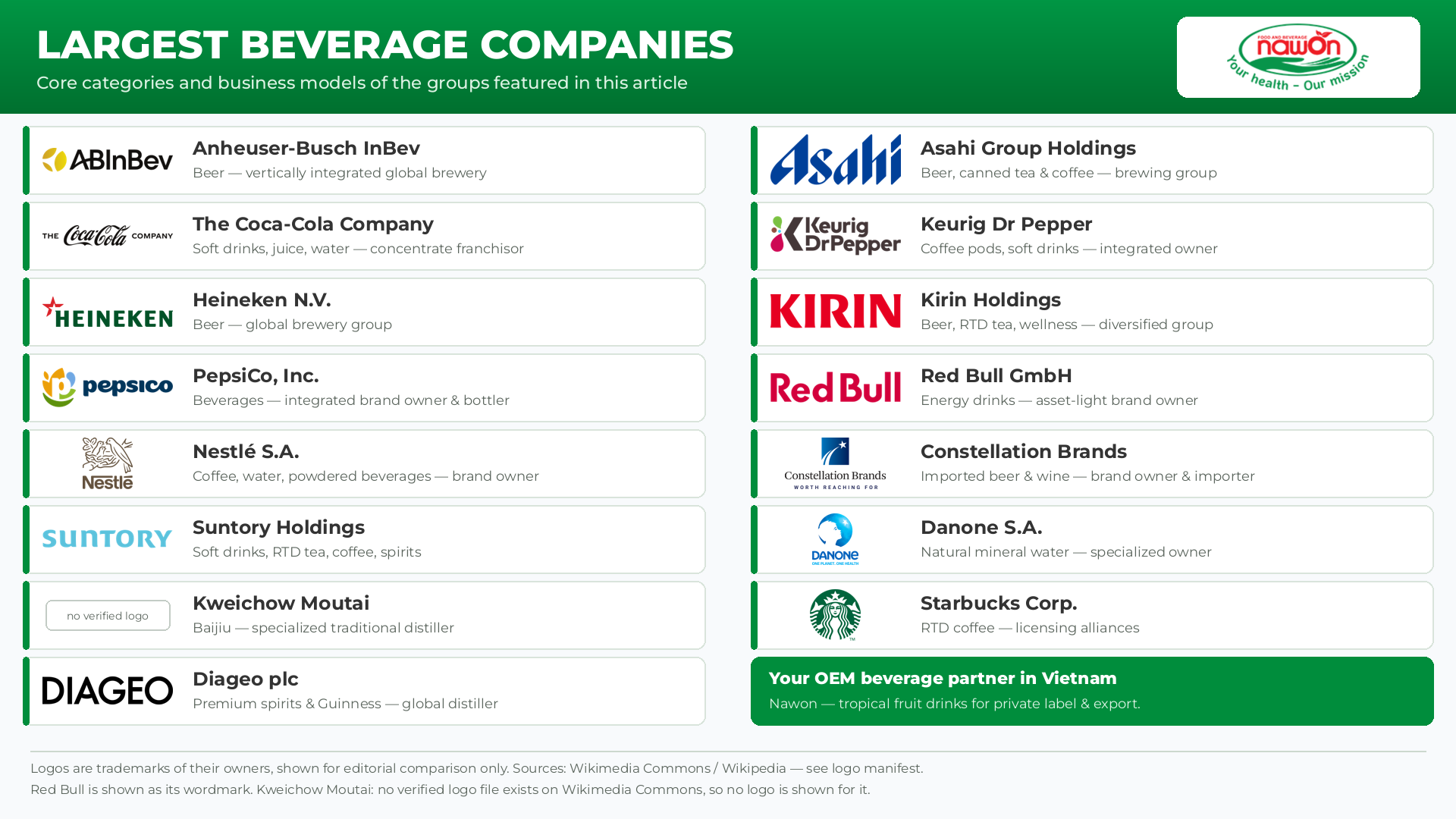
| Corporation & Ticker | Primary Product Categories | Operating Model | Beverage Segment Revenue | Reporting Period & Source |
|---|---|---|---|---|
| The Coca-Cola Company (NYSE: KO) | Carbonated soft drinks, fruit juice, bottled water, RTD tea & coffee | Brand Owner & Concentrate Franchisor | $47.94 billion USD | FY2025 Form 10-K (SEC) |
| PepsiCo, Inc. (NASDAQ: PEP) | Carbonated soft drinks, sports drinks, fruit juice, functional waters | Integrated Brand Owner & Bottler | ~$36.20 billion USD (Total group $93.93B) | FY2025 Form 10-K (SEC) |
| Anheuser-Busch InBev (EBR: ABI) | Premium beer (Budweiser, Corona, Stella Artois), cider | Global Integrated Brewery | $59.32 billion USD | FY2025 Audited Report |
| Nestlé S.A. (Beverage Segment) (SIX: NESN) | Instant/RTD coffee (Nescafé), natural mineral water | Diversified Brand Owner | CHF 28.70 billion (~$34.5 billion USD) | FY2025 Financial Report |
| Heineken N.V. (AMS: HEIA) | International lager beer (Heineken, Tiger), craft beer, cider | Global Integrated Brewery | €36.00+ billion EUR (~$38.8 billion USD) | FY2025 Annual Report |
| Suntory Holdings Limited (Private / TYO: 2587) | Canned coffee (BOSS), RTD tea, soft drinks, whisky | Conglomerate Brand Owner & Producer | ¥3,300+ billion JPY (~$23.0 billion USD) | FY2025 Consolidated Report |
| Danone S.A. (Waters Division) (EPA: BN) | Natural bottled mineral water (Evian, Volvic, Aqua, Badoit) | Specialized Brand Owner | €3.50+ billion EUR | FY2025 Annual Report |
| Keurig Dr Pepper Inc. (NASDAQ: KDP) | Keurig coffee pods, carbonated soft drinks, energy drinks | Integrated Brand Owner & DSD Network | $16.60 billion USD | FY2025 Form 10-K (SEC) |
| Red Bull GmbH (Private Company) | Functional energy drinks (13.97 billion cans globally) | Asset-Light Brand Owner (100% outsourced production) | €12.20 billion EUR (~$13.2 billion USD) | 2025 Financial Release |
| Starbucks Corp. (RTD Channel) (NASDAQ: SBUX) | Ready-to-drink canned/bottled coffee (Frappuccino, Cold Brew) | Brand Owner via Licensing Alliances | ~$1.85 billion USD | FY2025 Form 10-K (SEC) |
| Asahi Group Holdings, Ltd. (TYO: 2502) | Beer (Asahi Super Dry, Peroni), canned tea/coffee | Brewing & Beverage Conglomerate | ¥2,800+ billion JPY (~$19.5 billion USD) | FY2025 Integrated Report |
| Kirin Holdings Company (TYO: 2503) | Beer (Kirin Ichiban), RTD tea, immune/wellness drinks | Diversified Beverage & Health Science | ¥2,200+ billion JPY (~$15.2 billion USD) | FY2025 Annual Report |
| Diageo plc (LSE: DGE / NYSE: DEO) | Premium spirits (Johnnie Walker, Smirnoff), Guinness beer | Global Spirits & Specialty Distiller | £17.20 billion GBP (~$20.25 billion USD) | FY2025 Form 20-F |
| Constellation Brands, Inc. (NYSE: STZ) | Imported beer (Modelo Especial, Corona Extra in the US), wine | Brand Owner & Commercial Importer | $9.14 billion USD (Beer segment reached $8.32B) | FY2026 Form 10-K (SEC) |
| Kweichow Moutai Co., Ltd. (SSE: 600519) | Traditional Maotai liquor (Feitian Moutai, Jiang-flavor Baijiu) | Specialized Traditional Distiller | 160.00+ billion RMB (~$22.5 billion USD) | FY2025 Financial Report |
Detailed Enterprise Profiles
1. The Coca-Cola Company
Headquartered in Atlanta, Georgia, The Coca-Cola Company remains the preeminent non-alcoholic liquid refreshment enterprise in the world. Its portfolio includes flagship trademarks such as Coca-Cola, Sprite, and Fanta, alongside hydration and sports drink labels like Dasani, Smartwater, and Powerade, and ready-to-drink coffee brand Costa. In fiscal year 2025, Coca-Cola reported net operating revenues of $47.94 billion (an increase of 2% compared to $47.06 billion in 2024), driven by positive price/mix realization and a 1% expansion in concentrate sales volume. Operating income rose to $13.76 billion, delivering an operating margin of 28.7%.
The cornerstone of Coca-Cola’s commercial success is its asset-light franchisor structure. Rather than owning every packaging plant, the parent company manufactures proprietary beverage concentrates, syrups, and bases, which it then sells to authorized bottling partners. These independent bottling groups—such as Coca-Cola Europacific Partners (CCEP) and Arca Continental—invest the heavy capital required for water purification, carbonation, high-speed container filling, and direct retail distribution. Throughout 2024 and 2025, Coca-Cola continued refranchising company-owned bottling investments in India, Bangladesh, and the Philippines, reinforcing its high-margin concentrate core.
2. PepsiCo, Inc. (Beverage Operations)
Based in Purchase, New York, PepsiCo is an international consumer powerhouse generating $93.93 billion in total group net revenue in fiscal 2025 (up 2% year-over-year). While convenient foods such as Lay’s, Doritos, Cheetos, and Quaker oats accounted for 58% of consolidated sales, its dedicated beverage operations delivered approximately $36.20 billion globally. The standalone PepsiCo Beverages North America (PBNA) division generated $28.20 billion, supported by international beverage franchise revenue of $5.00 billion and regional EMEA beverage bottling volume.
PepsiCo utilizes a distinct operational strategy compared to its chief rival. Across North America, the company directly operates a substantial portion of its bottling plants and manages an integrated Direct-Store-Delivery (DSD) fleet. In overseas markets, it frequently partners with independent or joint-venture franchise bottlers to optimize local manufacturing and distribution. In August 2025, PepsiCo strengthened its functional beverage alignment through a landmark transaction with Celsius Holdings, expanding distribution rights for fast-growing performance brands including Alani Nu and poppi.
3. Anheuser-Busch InBev SA/NV (AB InBev)
Leuven-based AB InBev stands as the undisputed titan of the global brewing industry, posting total reported revenue of $59.32 billion in fiscal 2025, representing an organic revenue increase of 2.0% and underlying profit of $7.41 billion. Total commercial production volume reached 561.10 million hectoliters, with beer shipments accounting for 484.19 million hectoliters. The group controls a portfolio of over 500 beer brands, including globally recognized megabrands such as Budweiser, Stella Artois, Corona (outside the United States), Michelob ULTRA, and Beck’s.
AB InBev operates a vertically integrated industrial manufacturing footprint. The company owns and oversees state-of-the-art breweries across North America, Latin America, Europe, Africa, and Asia-Pacific. Its operations span precision malt cultivation, industrial fermentation, high-gravity brewing, and automated canning lines running at speeds upwards of 1,200 cans per minute. In 2025, AB InBev accelerated its non-alcoholic beer portfolio by 34%, led by Corona Cero, while expanding its Beyond Beer division (including Cutwater spirits-based RTD cocktails) by 23%.
4. Nestlé S.A. (Beverage Segment)
Switzerland’s Nestlé S.A. is the world’s largest food and beverage conglomerate, with aggregate 2025 group sales reaching CHF 89.49 billion (approximately $107.7 billion). When isolated from its pet nutrition, infant nutrition, and prepared dishes, Nestlé’s beverage division represents an imposing commercial force, recording approximately CHF 28.70 billion (roughly $34.5 billion) in annual liquid, soluble, and bottled beverage sales.
Nestlé commands dominant market share in coffee through iconic household brands Nescafé and Nespresso, alongside global powdered beverages like Milo and Nesquik. Its Nestlé Waters business controls premium international mineral water labels including S.Pellegrino, Perrier, and Acqua Panna. Nestlé relies heavily on company-owned roasting and aseptic packaging facilities, augmented by its Global Coffee Alliance with Starbucks, which packages and distributes retail Starbucks-branded coffee products worldwide.
5. Heineken N.V.
Headquartered in Amsterdam, Heineken N.V. is the second-largest brewing organization globally, operating more than 160 breweries across 70 countries. In fiscal 2025, net corporate revenue surpassed €36.00 billion (approximately $38.8 billion), propelled by double-digit volume growth in premium lagers and strong international adoption of Heineken 0.0.
In addition to its flagship Heineken green label, the group’s international brand stable includes Tiger, Amstel, Birra Moretti, Desperados, Sol, and Strongbow ciders. Heineken operates through a balanced manufacturing model: maintaining majority-owned industrial breweries in core domestic markets while entering licensed brewing agreements and regional joint ventures across emerging markets in Southeast Asia and Africa.
6. Suntory Holdings Limited
Osaka-based Suntory Holdings is a multi-category consumer beverage and distilling leader with annual consolidated revenue exceeding ¥3,300 billion (approximately $23.0 billion) in 2025. Its publicly traded soft drink subsidiary, Suntory Beverage & Food (TYO: 2587), generated over ¥1,600 billion of this total through high-volume ready-to-drink tea, canned coffee, and hydration drinks.
Suntory’s portfolio spans iconic Japanese brands such as BOSS Coffee and Suntory Tennensui mineral water, international soft drinks like Orangina, Lucozade, and Ribena, as well as an acclaimed spirits portfolio including Yamazaki, Hibiki, and Jim Beam. The company operates high-speed aseptic PET and aluminum canning facilities across Japan, Southeast Asia, and Europe, maintaining strict quality control over water purity and hot-fill extraction processes.
7. Danone S.A. (Waters Division)
Headquartered in Paris, Danone S.A. generated total corporate revenue of over €27.60 billion in 2025. While specialized nutrition and plant-based dairy form the bulk of group turnover, Danone’s dedicated Waters division generated €3.50+ billion in net sales, recording steady organic volume gains.
Danone is recognized globally for its premium natural mineral water springs, bottling renowned labels such as Evian, Volvic, Aqua (the dominant packaged water brand in Indonesia), Badoit, and Mizone functional vitamin water. Danone’s operational infrastructure focuses on sustainable watershed management, source-proximity bottling facilities, and high-speed lightweight PET packaging lines designed to minimize environmental impact.
8. Keurig Dr Pepper Inc.
Keurig Dr Pepper (KDP) is an integrated North American beverage powerhouse formed through the merger of Keurig Green Mountain and Dr Pepper Snapple Group. In fiscal 2025, KDP posted net sales of $16.60 billion, an increase of 8.2% from $15.35 billion in 2024. Its U.S. Refreshment Beverages segment drove $10.44 billion in sales (up 11.9%), while U.S. Coffee generated $3.99 billion and International operations added $2.17 billion. Disaggregated liquid refreshment beverage (LRB) net sales reached $11.60 billion, supported by K-Cup pod sales of $3.78 billion.
KDP’s brand stable includes Dr Pepper, Canada Dry, Mott’s, A&W, 7UP (in North America), Snapple, Core Hydration, and the Keurig single-serve brewing system. A significant driver of its 2025 top-line growth was the strategic acquisition of energy brand GHOST, alongside distribution partnerships for C4 Energy, Bloom, and Electrolit. In August 2025, KDP announced an agreement to acquire global coffee pure-play JDE Peet’s, accompanied by plans to separate its beverage and coffee portfolios into two standalone publicly traded corporations in 2026.
9. Red Bull GmbH
Fuschl am See-based Red Bull GmbH is the undisputed category leader in functional energy drinks, posting worldwide turnover of €12.20 billion (approximately $13.2 billion) in 2025—an 8.6% increase over 2024. Total sales volume reached a record 13.969 billion cans across 178 countries, translating to approximately 38 million cans consumed every single day. Net profit reached €1.9 billion.
Red Bull serves as the textbook case study of an asset-light consumer goods enterprise. The company owns zero canning plants or liquid processing lines. Instead, Red Bull focuses 100% of its resources on brand building, global sports marketing, and event sponsorships (reinvesting over €1.5 billion annually into athlete partnerships and racing teams). The entire physical production, liquid formula blending, water treatment, and high-speed aluminum canning process is outsourced to long-term contract manufacturing partners, primarily Austrian fruit juice and beverage co-packer Rauch Fruchtsäfte.
10. Starbucks Corporation (Channel Development)
While Seattle-based Starbucks Corporation generated over $36 billion in total corporate revenues in 2025 primarily from company-operated retail cafes, its Channel Development segment represents a major commercial force in packaged consumer beverages. Delivering approximately $1.85 billion in net segment revenues, this division monetizes ready-to-drink bottled and canned coffees through grocery, convenience, and e-commerce channels worldwide.
The portfolio includes popular convenience store staples such as Starbucks Bottled Frappuccino, Doubleshot Espresso, Starbucks Tripleshot Energy, and packaged Cold Brews. Rather than constructing its own consumer bottling facilities, Starbucks leverages strategic co-manufacturing partnerships: the North American Coffee Partnership (a 30-year joint venture with PepsiCo) and the Global Coffee Alliance with Nestlé. These partners manage commercial ingredient sourcing, thermal sterilization, container filling, and direct-to-retail cold-chain delivery.
11. Asahi Group Holdings, Ltd.
Tokyo-based Asahi Group Holdings generated consolidated net revenue exceeding ¥2,800 billion (approximately $19.5 billion) in 2025. Best known internationally for its flagship Asahi Super Dry beer, the conglomerate also commands major European premium brewing platforms including Peroni Nastro Azzurro, Pilsner Urquell, Kozel, and Grolsch.
Beyond alcohol, Asahi operates an expansive non-alcoholic beverage operation in Japan and the Asia-Pacific region, producing Wonda ready-to-drink canned coffees, Wilkinson sparkling water, and lactic acid beverages. Asahi operates high-volume, automated continuous-fermentation breweries alongside high-speed aseptic PET bottling plants engineered for high energy efficiency and rapid changeovers.
12. Kirin Holdings Company, Limited
Tokyo-based Kirin Holdings is a diversified food, beverage, and health science conglomerate reporting consolidated revenues of over ¥2,200 billion (approximately $15.2 billion) in 2025. Its beverage assets encompass Kirin Brewery (makers of Kirin Ichiban and owners of Australia’s Lion Brewery), Kirin Beverage, and American craft spirit distiller Four Roses Bourbon.
In the non-alcoholic space, Kirin dominates Japanese ready-to-drink teas through its Kirin Gogo-no-Kocha and Kirin Nama-cha lines, as well as Fire canned coffee. Kirin differentiates itself through its proprietary Health Science segment, leveraging pharmaceutical-grade fermentation technology to formulate functional beverages enriched with immune-supporting postbiotics and amino acids.
13. Diageo plc
London-based Diageo plc is the world’s leading producer of premium spirits, delivering net sales of £17.20 billion (approximately $20.25 billion) in fiscal 2025. Diageo controls an unmatched stable of heritage spirits, including Johnnie Walker Scotch whisky, Smirnoff vodka, Tanqueray gin, Captain Morgan rum, Don Julio and Casamigos tequilas, Baileys Irish Cream, and Guinness stout.
Diageo’s manufacturing model revolves around long-term capital investments in grain distilleries, barrel aging warehouses, and automated high-speed spirits bottling lines. The company operates historic distillation sites across Scotland, North America, Mexico, and Ireland, complemented by regional packaging facilities that blend, bottle, and seal spirits into custom premium glass packaging with high-security tamper-evident closures.
14. Constellation Brands, Inc.
Headquartered in Victor, New York, Constellation Brands posted consolidated net sales of $9.14 billion in fiscal 2026. Following the strategic divestiture of several entry-level commercial wine brands to focus on higher-margin premium assets, the company’s financial performance is overwhelmingly anchored by its Beer Division, which delivered $8.32 billion in net sales.
Constellation holds the permanent commercial rights to brew, import, and market Grupo Modelo’s iconic Mexican beer brands in the United States, including Modelo Especial, Corona Extra, Pacifico, and Victoria. Modelo Especial remains the number one beer brand by dollar sales in the U.S. tracked retail channels. To support this massive volume, Constellation operates mega-breweries in northern Mexico (including its Nava and Obregón facilities), which feature some of the largest automated fermentation tanks and high-speed packaging lines in the Western Hemisphere.
15. Kweichow Moutai Co., Ltd.
Based in Renhuai, Guizhou Province, China, Kweichow Moutai is the most valuable beverage corporation by market capitalization in Asia. Operating revenue in fiscal 2025 exceeded 160 billion RMB (approximately $22.5 billion), while generating extraordinary operating profit margins in excess of 80%.
Moutai produces Jiang-flavor Baijiu, China’s national spirit distilled from fermented sorghum and wheat. Its flagship product, Flying Fairy (Feitian Moutai), is aged in earthen jars for multiple years before blending. The company’s operations are tightly clustered along the Chishui River Valley, where distinct microclimatic conditions and solid-state pit fermentation techniques yield a scarce luxury product distributed through strictly managed commercial quotas and direct-to-consumer digital allocations.
The Value Chain: Brand Owners, Franchise Bottlers, and Contract Manufacturers
A frequent source of confusion for commercial buyers, retail sourcing managers, and beverage founders is determining how these global leaders actually manufacture their drinks—and whether emerging brands can work with them.
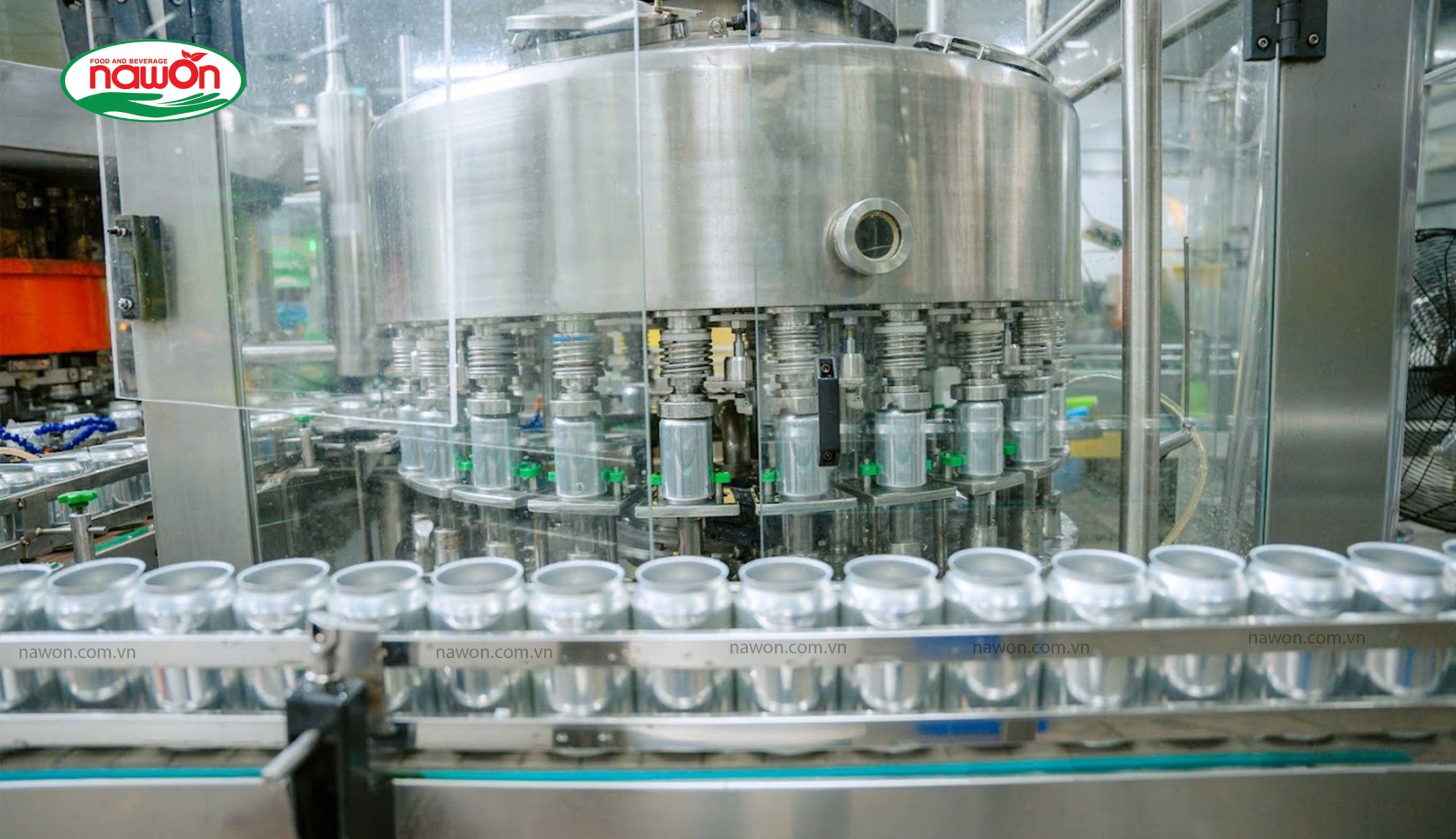 The commercial beverage industry is divided into three distinct operational tiers, each serving a different purpose in the supply chain:
| Value Chain Tier | Primary Role & Core Focus | Capital & Asset Profile | Commercial Accessibility for Third Parties |
|---|---|---|---|
| Brand Owners e.g., Coca-Cola, Keurig Dr Pepper, Red Bull |
Intellectual property, consumer marketing, formula R&D, brand positioning | Asset-light or marketing intensive; low heavy filling assets | Closed — Proprietary brand portfolios only; does not accept private-label orders |
| Franchise Bottlers e.g., CCEP, Arca Continental, Swire |
Regional packaging, water treatment, carbonation, direct-store delivery (DSD) | High capital (heavy canning, bottling, and fleet infrastructure) | Restricted — Exclusively serves authorized franchisor; captive line capacity |
| Contract Manufacturers (OEM / ODM) e.g., Nawon, specialized independent co-packers |
Custom formulation, batch thermal processing, container filling, export compliance & QA testing | High capital (flexible multi-format canning, bottling, and pouch filling lines) | Open for B2B — Co-packing & custom manufacturing for independent brands, importers, and private labels |
1. Brand Owners (Intellectual Property & Marketing)
Global giants like The Coca-Cola Company, Keurig Dr Pepper, and Red Bull GmbH are primarily brand owners. They invest heavily in brand building, global marketing, proprietary research, and regulatory positioning.
Because their commercial business model is built around proprietary brand equity, global brand owners do not manufacture private-label beverages for third parties. Independent importers and retail brands cannot hire Coca-Cola or Red Bull to formulate or pack a custom energy drink or juice line.
2. Franchise Bottlers (Captive Regional Co-Packers)
Franchise bottling partners—such as Coca-Cola Bottling Co. Consolidated, Coca-Cola Europacific Partners (CCEP), or Suntory PepsiCo Vietnam Beverage—own and operate the physical high-speed canning and bottling lines.
However, these facilities operate under strictly bounded contractual licensing agreements. Their processing capacity is legally and operationally dedicated to producing beverages for their parent franchisors. They do not accept third-party custom manufacturing or small-to-medium private-label runs.
3. Contract Manufacturers / OEM & ODM Partners (Open Commercial Facilities)
Businesses seeking to develop their own branded drinks, private-label retail collections, or wholesale beverage lines work with independent contract manufacturers. These specialized facilities provide commercial packaging lines, ingredient sourcing, quality testing laboratories, and custom formulation support without requiring multi-million-dollar capital investments from the client.
To understand which manufacturing partner fits your project scale, it helps to review the primary types of beverage manufacturers—from turnkey formulation developers (ODM) to locked-recipe copackers (OEM) and toll-filling facilities.
Strategic Guidance for Commercial Beverage Sourcing
For beverage distributors, retail category buyers, and private brand founders, examining the models of the world’s largest beverage companies provides valuable strategic lessons:
- Leverage Asset-Light Operations: As demonstrated by Red Bull and Starbucks’ Channel Development, owning brick-and-mortar factories is not a prerequisite for building a multi-million-dollar beverage brand. Outsourcing manufacturing to vetted contract partners allows brand owners to focus their working capital on distribution, branding, and sales velocity.
- Select Certified Manufacturing Hubs: Modern beverage buyers increasingly source ready-to-drink products from international agricultural powerhouses with advanced processing capabilities. Southeast Asia, and Vietnam in particular, has become a key hub for tropical juices, coconut water, RTD teas, and functional beverages due to direct raw material access and modern, certified manufacturing lines.
- Audit Facilities Against Global Standards: When evaluating manufacturing partners, buyers should verify quality credentials such as ISO 22000, HACCP, BRCGS, Halal, and U.S. FDA facility registrations. Sourcing teams can explore vetted industry evaluations of beverage manufacturers in Vietnam to assess factory equipment, thermal processing lines, and minimum order requirements.
Frequently Asked Questions
Which company is officially the largest beverage company in the world?
Depending on the measurement used, Anheuser-Busch InBev is the largest by total beverage sales ($59.32 billion in fiscal 2025, alcoholic), while The Coca-Cola Company is the largest pure-play non-alcoholic beverage enterprise ($47.94 billion in fiscal 2025). Although Nestlé and PepsiCo report higher total corporate revenues ($107.7B and $93.9B respectively), large portions of their business originate from packaged foods, snacks, and pet nutrition.
Why should beverage revenue be separated from total corporate revenue?
Diversified conglomerates operate across multiple consumer sectors. For example, PepsiCo’s snacks division (Frito-Lay) and Nestlé’s pet nutrition arm generate tens of billions in annual turnover that have no connection to liquid beverages. Evaluating beverage-specific segment revenue ensures an accurate, apples-to-apples comparison of manufacturing output and commercial footprint.
Does Red Bull own its beverage manufacturing plants?
No. Red Bull operates an asset-light business model. The company owns its formulas, marketing rights, and global trademarks, but completely outsources liquid processing, blending, and canning to industrial contract packaging partners, primarily Austrian beverage company Rauch Fruchtsäfte.
Can an independent brand hire Coca-Cola or PepsiCo to produce private-label drinks?
No. Multinational brand owners and their authorized franchise bottlers produce exclusively for their own proprietary brand portfolios. Companies looking to formulate and package private-label or custom beverages must partner with independent contract manufacturers (OEM/ODM).

Turning Your Beverage Concept into Commercial Reality: Why Nawon Is Your Ideal Manufacturing Partner
Studying the world’s largest beverage companies reveals a fundamental industry truth: long-term brand success does not depend on building expensive private bottling plants, but on owning your brand vision while partnering with a reliable, certified contract manufacturer. Whether you are actively researching global beverage market dynamics, looking to expand an existing retail portfolio, or planning to launch a disruptive ready-to-drink (RTD) beverage brand, finding the right production ally is the single most critical milestone in your journey.
This is where Nawon Food and Beverage bridges the gap between your concept and global retail shelves.
Complete End-to-End OEM & ODM Solutions
Entering the commercial beverage market requires navigating recipe chemistry, container engineering, thermal processing, and international food safety mandates. Nawon provides complete turnkey support across every stage of development:
- Custom Recipe Formulation (ODM): Our in-house beverage innovation laboratory and food scientists help you engineer proprietary flavor profiles—from balancing sweetness and acidity to functional ingredient fortification, including electrolytes, vitamins, prebiotics, and collagen.
- Flexible OEM Execution: If you already possess locked specifications or established recipes, our production engineering teams execute your exact formulation with strict batch-to-batch consistency and complete formula confidentiality.
- Complimentary Pilot Sampling: Test, taste, and refine your drink before committing capital. Nawon provides free R&D prototype samples to ensure sensory appeal, stability, and packaging compatibility meet your standards.
World-Class Infrastructure & Sourcing Advantages
Manufacturing with Nawon in Vietnam delivers structural cost efficiencies and direct agricultural advantages that multinational brand owners actively leverage:
- Industrial Scale: Operating two modern manufacturing facilities covering 90,000 square meters with 45 automated production lines, delivering a production throughput of up to 1,000 containers per month.
- Direct Agricultural Integration: Located at the heart of Southeast Asia’s agricultural belt, Nawon sources fresh tropical raw materials—including pure young green coconut water, not-from-concentrate (NFC) tropical fruit purees (mango, guava, passion fruit, lychee), aloe vera gel, and premium Vietnamese coffee.
- Packaging Versatility: High-speed packaging solutions across standard, sleek, and slim aluminum cans (250ml, 330ml, 500ml), PET bottles, heat-resistant PP containers, and premium glass bottles.
Certified Compliance for 100+ Export Markets
Regulatory hurdles and non-tariff trade barriers can halt a new beverage brand before retail distribution begins. Nawon eliminates compliance friction through globally accredited certifications:
- Tier-One Retail Standards: Active BRCGS (Grade A) and FSSC 22000 certifications, fulfilling mandatory supplier requirements for major supermarket chains across North America and Western Europe.
- Global Market Registrations: Fully registered with the U.S. FDA, alongside accredited ISO 22000, HACCP, HALAL, and USDA/EU Organic certifications.
- Startup-Friendly Order Scaling: Unlike captive mega-bottlers that demand multi-million-can commitments, Nawon offers competitive Minimum Order Quantities (MOQs) and container consolidation options, enabling ambitious brand founders to validate consumer demand while protecting operational cash flow.
Ready to Launch Your Beverage Brand?
If you have a beverage concept, an existing product ready to scale, or need expert guidance on private-label formulation, the team at Nawon is ready to assist.
- Explore Manufacturing Options: Review our comprehensive guides on OEM beverage manufacturing and private label beverage solutions to evaluate line formats and service models.
- Request Free Pilot Samples: Connect directly with our international export managers through the Nawon Contact Portal or via WhatsApp at +84 973 085 499 to receive product catalogs, technical feasibility consultations, and custom sample kits tailored to your target market.