

If you’re building a beverage brand, sooner or later, you hit a fork in the road:
- Do you invest in your own factory (in-house production)?
- Or do you partner with a co-packer (contract manufacturing/outsourcing)?
There’s no one-size-fits-all answer. The “right” move depends on your demand curve, cash position, quality requirements, and how much risk you’re willing to carry.
Below is a practical decision guide with ROI logic, factory risk reality checks, and what you gain from beverage co-packing.
The Core Difference
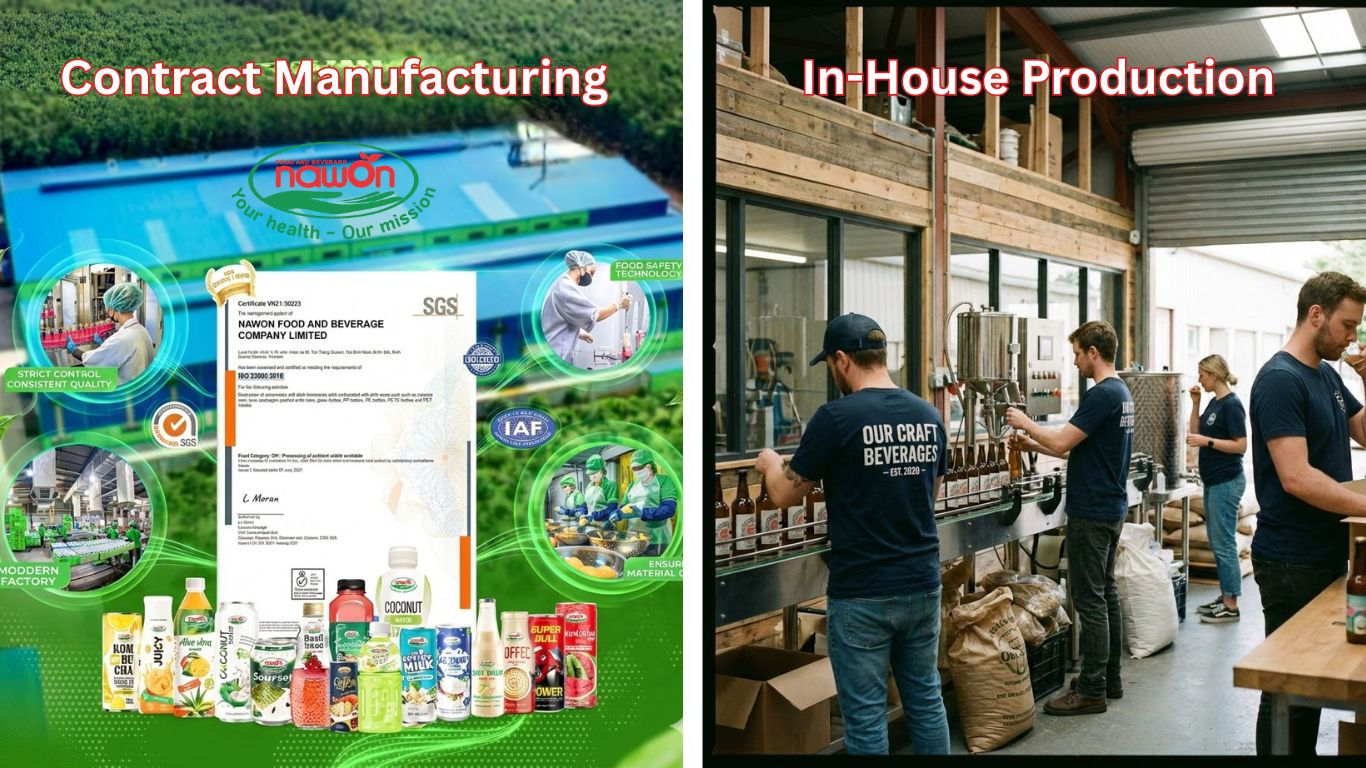
Contract manufacturing of beverages (outsourcing): You pay per unit to a third-party manufacturer with ready-to-run equipment, personnel, and certifications.
In-house production: You own the facility, staff, and process, end-to-end, with more control, but you absorb the fixed costs and operational headaches.
ROI: How to Think About Cost
When people compare costs, they often stop at “price per bottle.” That’s a trap.
A clean ROI comparison separates:
- CapEx (upfront investment): land, building, filling lines, boilers/chillers, water treatment, lab equipment, permits.
- Fixed OpEx (monthly burn): salaried staff, maintenance, utilities minimums, QA/QC, compliance, insurance, depreciation.
- Variable costs (per unit): ingredients, packaging, labor per shift, freight, testing.
A break-even example
Let’s say you’re choosing between:
- Outsourcing beverage manufacturing at $0.55/bottle
- In-house variable cost $0.35/bottle
- In-house fixed costs (incl. depreciation) $850,000/year
Break-even volume happens when:
In-house: 850,000 + 0.35×V
Outsource: 0.55×V
Set equal:
850,000 + 0.35V = 0.55V
850,000 = 0.20V
V = 4,250,000 bottles/year
Meaning: If you’re under ~4.25M bottles/year (in this simplified example), beverage co-packing can be the more cost effective beverage manufacturing route, because you’re not carrying a big fixed-cost base. And even if you are above that number, your decision still depends on risk, quality requirements, and how stable your demand is.
The Real Risks of Building Your Own Beverage Factory
Building a plant sounds like control. In practice, it can also become a slow-motion cash drain if demand doesn’t behave as expected.
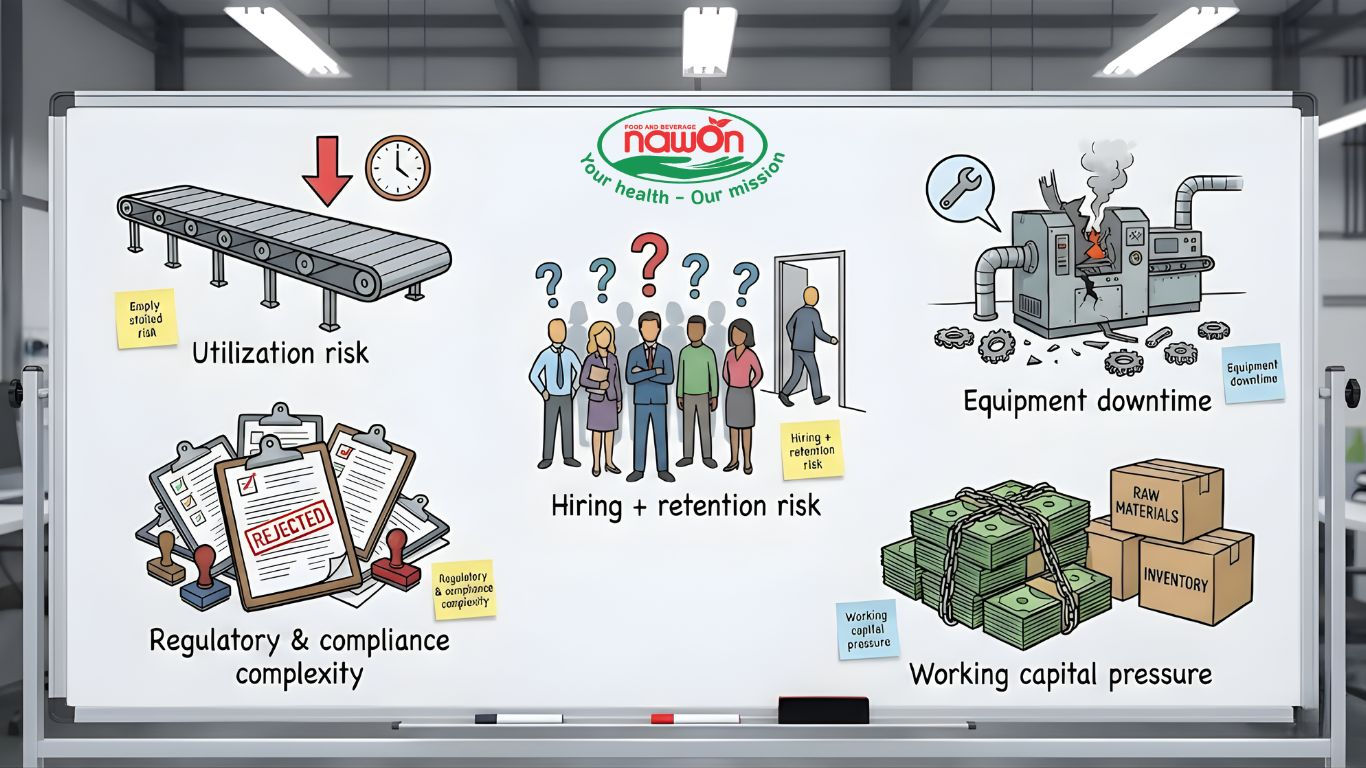
1) Utilization risk
A factory only “wins” financially when it runs at a healthy utilization rate. If your sales swing seasonally, or if distribution expansion takes longer than planned, you’re paying for idle capacity.
2) Regulatory & compliance complexity
Food safety systems, traceability, hygiene zoning, lab testing schedules, and documentation discipline are not “set and forget.” One missed detail can mean rejected lots, delayed shipments, or worse.
3) Hiring + retention risk
A production line isn’t just about operators. You need:
- QA/QC leadership
- maintenance technicians
- production planners
- procurement + inventory control
- EHS / compliance roles (depending on scale)
Hiring is one challenge. Keeping a trained team is another.
4) Equipment downtime and hidden maintenance costs
Fillers, pasteurizers/UHT systems, labelers, conveyors downtime isn’t rare, it’s normal. Your cost model needs to include:
- spare parts inventory
- planned maintenance
- emergency repairs
- vendor service contracts
5) Working capital pressure
Owning production often forces you to buy larger batches of raw materials and packaging to keep lines running efficiently, tying up cash in inventory.
Why Choose Contract Manufacturing? Key Advantages for Beverage Brands
When done right, contract manufacturing beverage partnerships aren’t about giving up control; they’re about buying time, capability, and flexibility.
Upside #1: Low upfront investment (and faster learning)
Instead of sinking capital into a factory before your product-market fit is proven, you can:
- test SKUs
- adjust formulation
- iterate packaging
- scale as the distribution grows
Upside #2: Speed to market
A good beverage co-packing partner already has:
- validated lines
- trained staff
- QA programs
- supplier networks
That cuts months (sometimes years) off your timeline.
Upside #3: Cost advantages in the right regions
This is where geography matters.
Many brands pick outsourcing beverage manufacturing in markets that offer:
- competitive labor costs
- strong ingredient sourcing
- export-ready supply chains
If your products lean on fruit-forward profiles, regions with abundant tropical fruit supply can be a significant edge, such as mango, passion fruit, guava, pineapple, coconut, and calamansi-style citrus, often with shorter sourcing routes and better freshness windows.
Upside #4: Access to specialized expertise + equipment
Whether you’re doing hot-fill, aseptic, carbonation, functional ingredients, or sensitive flavors, co-packers that run those lines every day reduce the “first time doing this” risk.
In-House Production: When It Genuinely Makes Sense
Despite the risks, in-house can be the best move when you have the right conditions.
Choose in-house when:
- You have high-volume, steady demand
- Your product requires extreme process control
- You need tighter protection around trade secrets/IP
- Your cost advantage is real at your expected utilization
- You can operate like a manufacturer (not just a brand)
In-house is less about “control” and more about operational maturity. If your team can run a plant efficiently, the economics can be strong.
Key Comparison Table
| Feature | Contract Manufacturing (Beverage Co-Packing) | In-House Production |
|---|---|---|
| Capital investment | Low (lower barrier to entry) | High (facility, equipment, staff) |
| Control & quality | Shared control (depends on partner + specs) | Highest (full oversight) |
| Scalability | High (add volume faster) | Limited by facility size/lines |
| Speed to market | Fast (uses existing setup) | Slower (build + hire + validate) |
| Cost structure | Mostly variable (pay per unit) | Heavy fixed costs + variable |
| IP protection | Higher risk if not contracted well | Stronger (internal) |
| Best for | Startups, new launches, unpredictable demand | Stable high volume, unique processes |
The Hybrid Model: What Many Innovative Brands End Up Doing
A common “best of both worlds” approach:
- keep critical/highly proprietary steps in-house (or tightly controlled)
- outsource high-volume routine production to a co-packer
This can protect what matters most while keeping your cost base flexible.
How to Choose a Co-Packer Without Losing Control
If you’re leaning toward beverage co-packing, you don’t have to accept mystery and “trust us” vibes. You can lock control into the relationship through specs and process.
Here’s a partner-check list that actually prevents problems:
Questions that matter
- Quality system: What certifications and QA routines are standard? (prevents “we’ll figure it out later”)
- Ingredient traceability: How do they track lots from intake to finished goods? (recall readiness)
- MOQ + run sizes: Do minimums match your real forecast? (avoids inventory pileup)
- Lead times + scheduling: How far out do you need to book production? (protects launch calendars)
- Formulation ownership: Who owns the formula and process documentation? (IP clarity)
- Change control: What happens when you tweak flavor, sweetener, or packaging? (consistency)
- Contingency: If a line goes down, what’s the backup plan? (supply continuity)
If you’re evaluating co-packing, manufacturers like Nawon can usually share practical benchmarks (MOQs, lead times, packaging options, testing flow, tropical fruit sourcing) that help you compare partners before you commit.
Decision Framework
Pick a contract manufacturing beverage if:
- You want cost-effective beverage manufacturing without heavy CapEx
- Demand is uncertain or seasonal
- You need a faster time-to-market
- You’re expanding distribution and don’t want your factory to become the bottleneck
Pick in-house if:
- The volume is high and stable
- Your team can operate manufacturing at scale
- Your product needs ultra-tight control or proprietary processing
- You can afford the time + capital + operational risk
FAQ
Is beverage co-packing cheaper than in-house production?
Often, yes, at low-to-mid volumes, because you avoid fixed costs and upfront investment. At high, stable volumes, in-house can win if utilization stays strong.
What’s the most significant risk of outsourcing beverage manufacturing?
Misaligned quality expectations and unclear ownership of specs/formulation. You solve that with tight documentation, testing requirements, and a solid contract.
Can I protect my IP with a contract manufacturer?
Yes, if you structure agreements correctly (confidentiality, formula ownership, limited access, change control, audit rights). IP risk is real, but manageable.